
Wednesday, 11 July 2012
Lewisvale Park (Inveresk) inscriptions

Thursday, 29 March 2012
RIB III indices
Further to a couple of earlier posts:
The Journal of Roman Archaeology currently has a number of pdf copies of recent reviews available on its website. Of particular interest is the review of RIB III by Antony Birley. Of much interest in itself in fact, but of particular interest in that he has gone to the effort of producing a series of indices, lacking from the volume itself.
Find it here, at least for the time being. Probably best save yourself a copy. My earlier link to a review by Hurst (on Roman Gloucester) seems still to be live even though it no longer appears on the JRA page, but who knows for how much longer...
The Journal of Roman Archaeology currently has a number of pdf copies of recent reviews available on its website. Of particular interest is the review of RIB III by Antony Birley. Of much interest in itself in fact, but of particular interest in that he has gone to the effort of producing a series of indices, lacking from the volume itself.
Find it here, at least for the time being. Probably best save yourself a copy. My earlier link to a review by Hurst (on Roman Gloucester) seems still to be live even though it no longer appears on the JRA page, but who knows for how much longer...
Saturday, 17 March 2012
La Colonnette Mafféienne
Which is to say CIL VI 3492 = ILS 2288, the list of legions inscribed on a column (or two: one is long lost) from the forum at Rome in the reign of Marcus Aurelius.
I don't think I've ever seen it named in this (or any) way in the literature except here:
Les légions romaines sur le Forum : recherches sur la Colonnette Mafféienne
Discovered in the 16th century, it appears to have originally been in the collection of Cardinal Maffei before its transfer to the Vatican Museum (sadly, much of the inscription gallery was closed when I visited; in fact I'm not sure some parts ever form part of the standard itinerary). Photographs are hard to come by - copyright issues prevent it from appearing in the online version of the above article - but I did manage to find one [here].
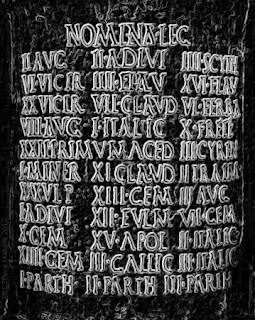
This is a partial reconstruction (quite apart from the rest of the image treatment) - parts of the surface of the original have been damaged and the reading of other parts (painted in at some [long] past date) leaves something to be desired. This represents the generally agreed text.
I don't think I've ever seen it named in this (or any) way in the literature except here:
Les légions romaines sur le Forum : recherches sur la Colonnette Mafféienne
Discovered in the 16th century, it appears to have originally been in the collection of Cardinal Maffei before its transfer to the Vatican Museum (sadly, much of the inscription gallery was closed when I visited; in fact I'm not sure some parts ever form part of the standard itinerary). Photographs are hard to come by - copyright issues prevent it from appearing in the online version of the above article - but I did manage to find one [here].

This is a partial reconstruction (quite apart from the rest of the image treatment) - parts of the surface of the original have been damaged and the reading of other parts (painted in at some [long] past date) leaves something to be desired. This represents the generally agreed text.
Friday, 3 February 2012
Ptolemy's Germany
Thinking further about Kalefeld and its implications for Roman involvement deep into Germany as late as the 3rd century, I was reminded of this project on Ptolemy's mapping of Germania Magna. Taken at face value (which the researcher's seem to have done) the map suggests quite detailed knowledge of peoples and places as far east as the River Vistula in modern Poland.
Not the first attempt to 'correct' Ptolemy (see eg Strang in Britannia 1997). All such depend on an assumption that his information was reliable, and essentially accurate, and that systematic errors can be identified and corrected for. Not easy assumptions. In fact Germania Magna provides a case in point (noted as long ago as 1917). The first two places listed are evidently lifted from Tacitus (not what you'd call a geographic text), the second entirely imaginary, but both confidently provided with coordinates.
First we get Φληούμ (Flevum), closely followed by Σιατουτάνδα (Siatutanda). Turn to Tacitus Annals 4.72-74 and you will find description of the Frisian revolt of AD28. Reinforcements arrive to the relief of Flevum castellum only to find that the Frisians have retired 'ad sua tutanda' - 'to protect their homesteads'. It seems very much as if a Greek speaking compiler has not understood this phrase and has just lifted two supposed places from here and placed them on the map. The fact that an imaginary place can be provided with coordinates casts doubt over any place within his text for which we lack independent confirmation. Even if Ptolomy was correctly informed of the names of places within 'free' Germany, we cannot necessarily assume that his locational information was accurate.
Not the first attempt to 'correct' Ptolemy (see eg Strang in Britannia 1997). All such depend on an assumption that his information was reliable, and essentially accurate, and that systematic errors can be identified and corrected for. Not easy assumptions. In fact Germania Magna provides a case in point (noted as long ago as 1917). The first two places listed are evidently lifted from Tacitus (not what you'd call a geographic text), the second entirely imaginary, but both confidently provided with coordinates.
First we get Φληούμ (Flevum), closely followed by Σιατουτάνδα (Siatutanda). Turn to Tacitus Annals 4.72-74 and you will find description of the Frisian revolt of AD28. Reinforcements arrive to the relief of Flevum castellum only to find that the Frisians have retired 'ad sua tutanda' - 'to protect their homesteads'. It seems very much as if a Greek speaking compiler has not understood this phrase and has just lifted two supposed places from here and placed them on the map. The fact that an imaginary place can be provided with coordinates casts doubt over any place within his text for which we lack independent confirmation. Even if Ptolomy was correctly informed of the names of places within 'free' Germany, we cannot necessarily assume that his locational information was accurate.
Thursday, 26 January 2012
Binchester redux
The latest (which is to say, only the second) Epistula newsletter is out from the Roman Society. In it a note on the past season at Binchester including almost exactly the form of words used in Current Archaeology interpreting the inscription. So 'dedicated by' may come from David Mason and not be down to the editors of CA. It's still not right...
While I'm back on that subject: Sacellum? I've only the photo to go on, but after SAC we have a reversed E ligatured with another letter. Is there the lower bar of an L there? I thought perhaps we might just see the foot of an R. But... the context may fit sacellum better and without seeing it, I'd have to defer to RSOT (in fact I'd probably have to anyway!).
While I'm back on that subject: Sacellum? I've only the photo to go on, but after SAC we have a reversed E ligatured with another letter. Is there the lower bar of an L there? I thought perhaps we might just see the foot of an R. But... the context may fit sacellum better and without seeing it, I'd have to defer to RSOT (in fact I'd probably have to anyway!).
Thursday, 19 January 2012
Kalefeld Roman Battlefield
While arguments here rage still (well, perhaps 'rage' is a little strong) over the possible site of Boudicca's last stand, and largely on the basis of topography alone, interesting news from Germany. As if finding the site of the Varusschlacht at Kalkriese wasn't enough, news of a new battlefield, much further into Germany, at Kalefeld. Lots of discussion over at RomanArmyTalk.

This too seems to have begun as a series of metal detector finds (dating back to at least 2008) followed up by targeted excavation. Coin evidence and C14 places the date at or after 235 and a historical context is posited in German campaigns of Maximinus Thrax. At this date the nearest permanent bases were 150 miles away on the Rhine, so this army (however constituted) was a long way from home. The metal finds reported recently are spectacular. The inscribed dolabra places some element at least of legio IIII Flavia at the scene.

This too seems to have begun as a series of metal detector finds (dating back to at least 2008) followed up by targeted excavation. Coin evidence and C14 places the date at or after 235 and a historical context is posited in German campaigns of Maximinus Thrax. At this date the nearest permanent bases were 150 miles away on the Rhine, so this army (however constituted) was a long way from home. The metal finds reported recently are spectacular. The inscribed dolabra places some element at least of legio IIII Flavia at the scene.
Wednesday, 4 January 2012
Recent Binchester inscription
Some initial comments by RSO Tomlin are reported in the article in Current Archaeology 263. He prefers Sace[llum, shrine, and the text might make more sense as recording the dedication of such. However, I must assume his comments have been simplified for publication - cui praeest does not mean 'dedicated by'. The formulation is surely going to require that the dedication, whether or not of a shrine, is made by the army unit in garrison, cui praeest [insert name] praefectus equitum, 'under the command of [unnamed] prefect
Subscribe to:
Posts (Atom)